
Iron Bacteria: Facts & Fiction
“What are Iron Bacteria?”
This question was asked by several attendees at the recent WQI Well Driller and Pump Installer training session, and rightfully so. “Iron bacteria” has become a buzzword in the well water industry, but it is rarely explained in terms of the bacterial significance to a well’s water quality. This lack of explanation leaves well drillers and pump installers unequipped to answer their clients’ concerns and properly address underlying water quality issues in wells.
Iron Bacteria and Broad Terminology
“Iron bacteria” is a broad term used for a group of bacteria that collect and oxidize iron in their environment. This group includes various species of bacteria, including, but not limited to, the genus of Gallionella, Siderocapsa, and Leptothrix. A common misconception is that iron bacteria are iron. Instead, iron bacteria tend to congregate in areas where iron is available, whether that metal is naturally present in the source water or is being released from mineralogy via corrosion unrelated to the iron bacteria.
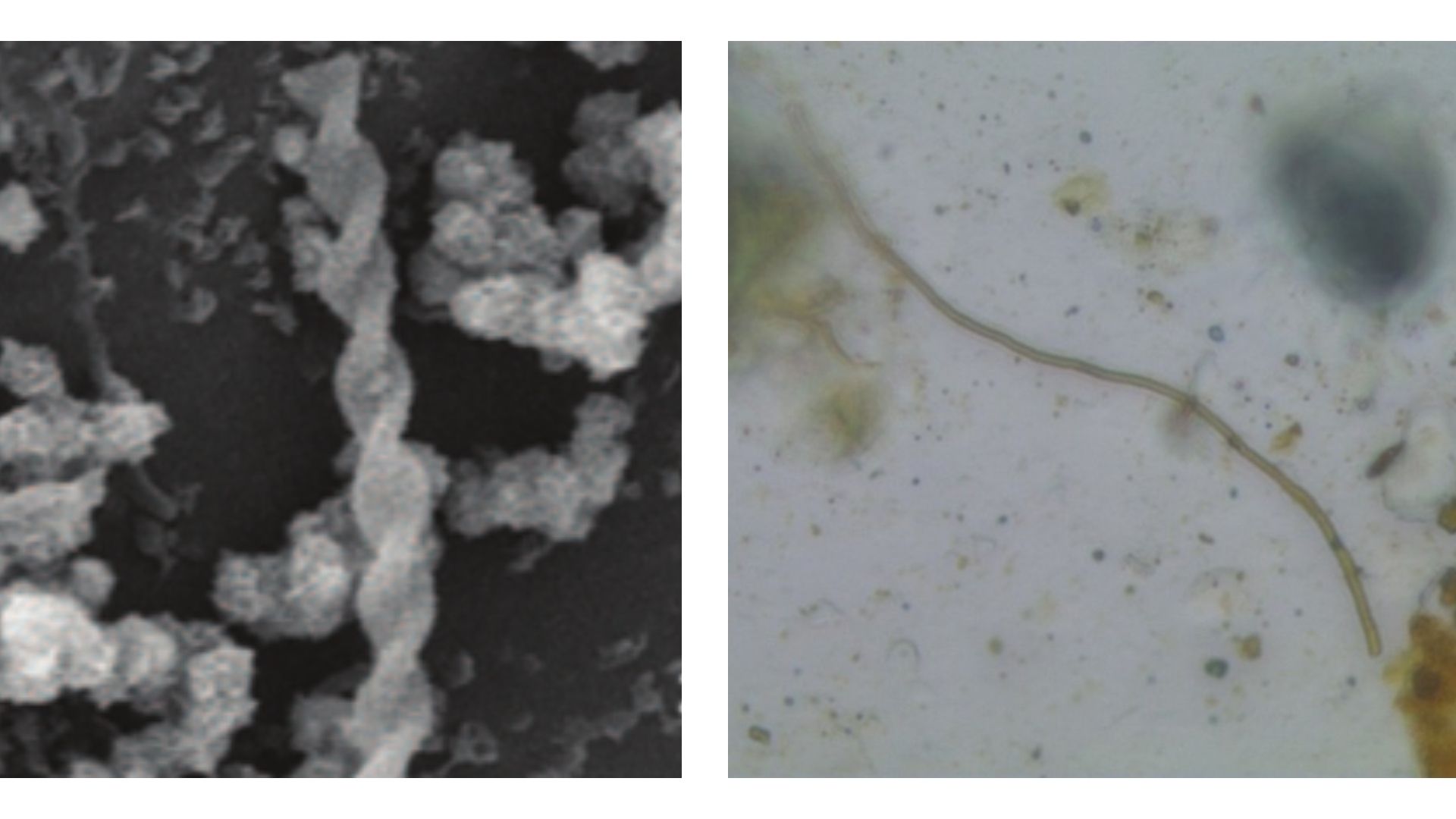
Above Left: a twisted stalk produced by a species of Gallionella bacteria (image courtesy of Lin, Chaofeng & Larsen, et al. 2010). Above Right: stalk produced by a species of Leptothrix bacteria (image courtesy of Water Quality Investigations, 2021).
In the field, iron bacteria are usually suspected when a system has a red or brown slime (i.e. biofilm) or water has an oily sheen. The slime, or biofilm, that is naturally produced by these bacteria acts as a protective layer where iron and other metals can be accumulated for biological processes. In the above pictures of Gallionella and Leptothrix, the bacteria can be seen forming “stalks” that facilitate metal usage and contribute to this slime. Water impacted by iron bacteria may also have a rotten egg, sewage, or fuel/oil odor due to the compounds naturally secreted by the bacteria.
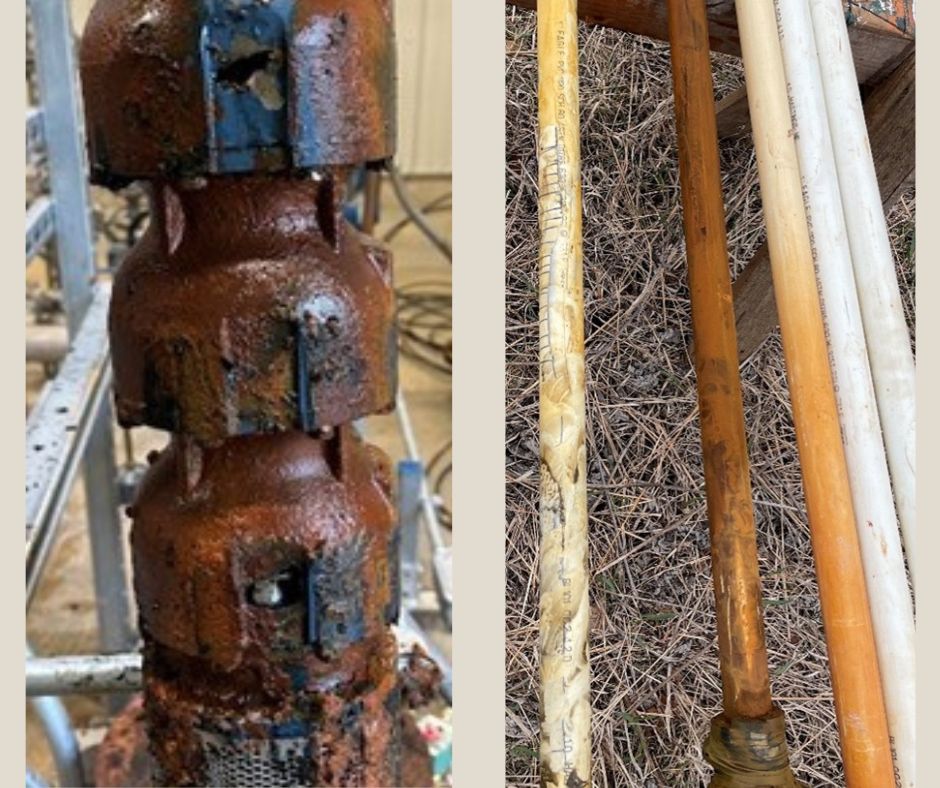
Pictured: (left) a corroded well pump removed from a well experiencing corrosion issues, (right) a column pipe pulled from a well that tested positive for iron bacteria
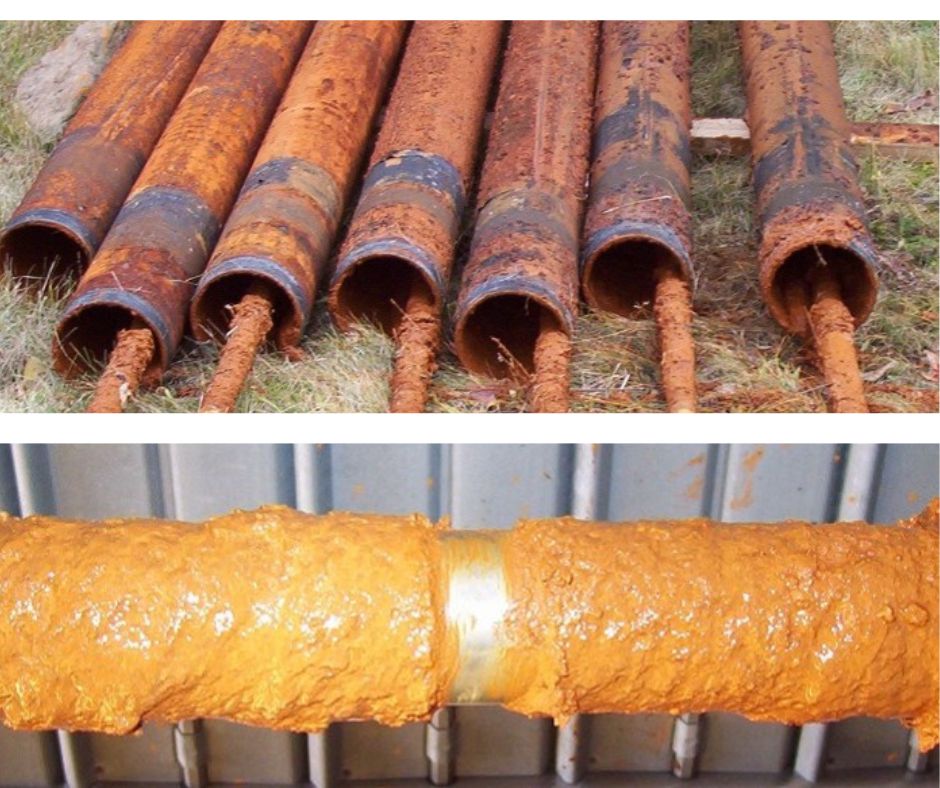
Column pipes taken from different wells during a pump removal. The red-brown build-up on the pumps and column pipes could be interpreted as caused by iron bacteria (Images courtesy of Water Quality Investigations).
The presence of iron bacteria is often confirmed by lab analysis for the broad category of iron bacteria. These typically culture select species of iron bacteria and provide estimates of the amount of bacteria in a water sample, such as “0.0 CFU/mL Leptothrix” and “2,400 CFU/mL Gallionella.” Although informative, this kind of report can be confusing for clients and leaves them without much insight into the severity of the iron bacteria and what to do about them. This is a problem many homeowners mention when they contact WQI about the iron bacteria in their wells.
What do I do when I have Iron Bacteria?
What you do to address iron bacteria depends on what is causing them to be present in your well/water system, which is usually not determined with a simple culture test. The following are scenarios that can lead to iron bacteria colonizing your well and water system:
- Metals and iron from the source water. When iron is present in water, iron bacteria will want to utilize it. Although iron bacteria are not iron itself, water systems that are supplied by wells that produce water with iron levels that promote iron bacteria growth may benefit from an iron removal system. High iron levels that prompt a treatment system should be verified to determine if the high iron is coming from the source water or caused by corrosion of the well mineralogy, casing, or equipment.
- Iron released from mineralogy via corrosion. A common misconception is that iron bacteria are the root cause of corrosion in a water system, but the reality is a little more complex. It is more appropriate to look at the conditions in the water system that are supporting the presence and growth of iron bacteria, such as biofilm, and look at how those impact the corrosion potential within the water system. When a thick biofilm is established within a well or water system, the prevalence of other bacteria that can cause Microbial Influenced Corrosion (MIC) is higher. These other bacteria, which are not detected when culturing for iron bacteria, often contribute to water quality issues while iron bacteria take the blame. Iron bacteria are typically present when corrosion is already occurring within the water system, benefitting from the metals released as corrosion products, instead of being the sole cause of corrosion itself.
As previously mentioned, iron bacteria are a symptom of an underlying issue; they can be perceived as a “canary in a coal mine” for biofilm and corrosion issues in a well and plumbing system. If iron bacteria are suspected (or confirmed by laboratory analysis) to be impacting a water system, further testing should be performed to assess water conditions and underlying causes. At WQI, the Biofilm Indication Test (BIT)™, Biofilm Activity Test (BAT)™, and Metals and Nutrient Analysis performed by a partner laboratory help identify this underlying cause and provide clients with the necessary actions to minimize its impact on water quality and corrosion.
Iron Bacteria: A Symptom not a Source
Shifting the perspective towards iron bacteria, from a source of corrosion to a symptom of corrosion, is critical in addressing water quality concerns. The next time you notice reddish or brown slime accumulating in your water system, consider what it might be telling you: is iron naturally high in the aquifer supplying the well, or is corrosion occurring in the well that is releasing the iron utilized by iron bacteria? Answering these questions gives a better understanding of water quality, biofilm, and the issues that may arise, including, but not limited to, iron bacteria.