To Spa or not to Spa
Jjimjilbang. It is one of the few Korean words I know, third only to Annyeonghaseyo (Hello) and Gamsahabnida (Thank you). I still remember the kind local I sat next to at a jogyok (Korean footbath) who had recommended visiting a jjimjilbang, repeating the word until I got the pronunciation correct. I can recall my close friend’s face lighting up as she emphatically recounted her jjimjilbang experiences, and how she insisted it was a “must-do” activity while in South Korea.
Encouraged by these reviews, I experienced my first jjimjilbang in Seoul a little over one week ago. They were all right—the jjimjilbang was one of the most unique and fun experiences I had while in the city. Despite all of these wonderful reviews, as I sat in a 41°C bath, I could not help but wonder what might be lurking in each droplet of water. I had already come to terms with the fact that I and everyone else in the spa was naked—years spent in changing rooms for sports have left me with little qualms in that area—and even the body scrub by a respectful, yet incredibly thorough, attendant was not enough to send me running from the spa. Yet there I was in the middle of my vacation, acutely aware of the work I’ve done involving Legionella risk assessments and water management plans and all of the facilities back home that have tested positive for Legionella.
I have been to spas around the world, including Icelandic hot springs, Turkish baths, and now the Korean jjimjilbang. The experience is not new to me, but when you consider my background in microbiology, public health, and Legionella, you might wonder why on earth I would allow myself to take that risk. When I step into a spa, I do not leave my Legionella knowledge at the door—if I see a stagnant, lukewarm tub or scum on a showerhead, I avoid them at all costs—but I have learned to use the version of me that performs Legionella risk assessments and facility surveys to my advantage. My background does not mean that I must avoid these types of facilities. Rather, it gives me the tools to spot warning signs when the risk of Legionella growth and transmission may be high enough to warrant passing on the experience altogether.
However, the average person does not have this skill set. Judging by how many people are constantly shuffling in and out of these spas, their popularity is unlikely to decline any time soon. Educating the public on the risks inherent to spas is a commendable effort, but it does not stop the source of the problem. Additionally, Legionella can be present in plumbing systems without any obvious warning signs. The consumer’s behavior can only go so far in preventing illness, which is why it is crucial that facilities have proper water management.
My family visits a local Wisconsin spa on a nearly annual basis. Over the years, I’ve seen how the facility has changed. In one area, a beautiful, recessed whirlpool spa sat next to a Swedish shower. One year, the whirlpool spa had been shut down and a sign posted saying it was down for maintenance. The next year, the whirlpool spa was gone entirely, replaced with a smooth, tiled floor, a set of deck chairs, and a coffee table featuring a tasteful array of magazines. The door to the Swedish spa was locked, the sign on its door indicating it was indefinitely out of commission. My Legionella senses immediately piqued—the two aerosol-generating fixtures, located closely together and likely on the same leg of piping, had been shut down. I could not help but suspect they had recurring issues with Legionella or other waterborne pathogens and decided to eliminate them altogether.
Instead of allowing visitors to assume that risk, the facility shut down the whirlpool spa and Swedish shower. This type of diligence is needed to protect public health. Unfortunately, whether a facility implements water management, Legionella testing, and appropriate corrective actions is often dependent on the facility’s risk factors, and obligations for maintaining water quality are often a grey area requiring interpretation.
Responsibility and Accountability
Responsibility for water management in facilities is often left to facility management. Regulatory requirements, time, cost, and personnel constraints are major factors in whether water management is performed and successfully reduces risk for Legionella and other waterborne pathogens. In the United States, ASHRAE Standard 188 sets guidance for managing water systems to reduce illness caused by Legionella and other waterborne pathogens. However, as a Standard, it is not automatically required by law for every building plumbing system. It only becomes mandatory when adopted by state or local codes or when required by the Center for Medicare and Medicaid Services (CMS) for certain healthcare facilities. Even then, a facility only has to comply if its water system poses specific risk factors or contains aerosol-generating devices.
In Seoul, the Seoul Institute of Health and Environment regularly conducts Legionella testing at private and commercial multi-use facilities, hospitals, elderly welfare facilities, and high-rise department stores. If the facility implements a water management plan to reduce the risk of Legionella, they are held accountable with this testing. Any facility that tests positive must implement corrective action and retest. This differs from the United States government, which conducts Legionella testing in federally owned facilities. Private and commercial facilities are only required to test for Legionella if they have the above-mentioned risk factors or are required to do so under state or local jurisdiction.
Of course, testing is not the only step in water management, but it holds facilities accountable and validates the effectiveness of water management activities. This accountability looks different depending on which state, jurisdiction, and country you are in.
"My background does not mean that I must avoid these types of facilities. Rather, it gives me the tools to spot warning signs when the risk of Legionella growth and transmission may be high.”
Deep Breaths, Open Eyes
Regardless of where you are and what water management requirements are being followed, there are signs that the spa you are visiting is implementing water safety practices (and when they might not be). If you have concerns, you should know what to keep an eye out for. The following are things I look for when visiting a spa:
Water Hygiene and Cleanliness
-
- Cleanliness is a must when visiting a spa, but it is much deeper than fresh linens and regularly changed garbage bins. Check the water taps, showerheads, and other fixtures to see if they have buildup or crust. This buildup often means the fixtures have not been cleaned or that water quality is promoting biofilm growth at the tap. If biofilm is growing at the tap, it is definitely growing in the piping leading to that tap.
- Water hygiene is critical for every water system. Water hygiene encompasses activities and system operations that maintain water quality in a water system. Inadequate water hygiene allows the growth of biofilm and waterborne pathogens and appears as stagnant bodies of water, lukewarm water in areas that are meant to be hot, and water usage. Sitting water is more likely than moving water to support the growth of Legionella and waterborne pathogens.
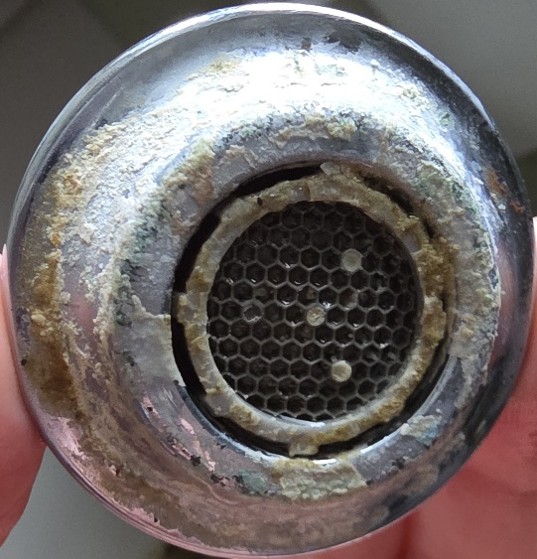
Crust build up on the outside of a faucet aerator. – Photo courtesy of Katie Maegli
- Signs indicating the water has been tested. In some cases, there will be an inspection sheet or sign-off list indicating the last time the water was tested. Anyone in the water quality industry can tell you that these check off lists are only as good as the people implementing them, and whether they are properly tested before being signed off is a matter of training.
- Ask someone. The success rate of this is hit or miss. Most of the time, the people you are speaking to are front of house or receptionists with little involvement in the water testing and water management side of things, but they can try to get you in touch with someone who is. When you add in a potential language barrier, things get a little more difficult, but it is worth a try.
- Aerosol generating devices. If the facility has passed all of the above checks and you are still worried, you can avoid aerosol-generating devices (whirlpools, showers, misters, etc.). This is especially difficult in a spa environment, but distancing yourself from an aerosol-generating device can help reduce the amount of water droplets you inhale.
This list is not exhaustive, but each item follows the same thought process: if you know what to look for and are aware of your personal risk factors for Legionellosis, you can make an informed decision.
Addressing the Source, Protecting Public Health
The majority of this article has been dedicated to the visitor’s experience in a spa, but real protection occurs on the facility management side of spa operations. At Water Quality Investigations, we work closely with facility personnel to ensure they are properly managing their water systems to reduce the growth and transmission of Legionella and other waterborne pathogens. Our Source-to-Tap Approach examines water quality from the entry point to the building to the point of use, providing insight to where problems begin and how to respond accordingly. The benefits of this approach do not stop at Legionella; our testing and recommendations have helped facilities experiencing corrosion, overgrowth of biofilm in piping, inadequate disinfectant residuals at distant points in their plumbing systems, and aesthetic issues (taste, odor, discoloration).
If you own and operate a spa, WQI can help you implement a water management program and validate the effectiveness of your current efforts. By addressing the source of water problems, both you and your guests can have peace of mind.